Academic & Study Interests

Overview

My academic and professional journey resides at the intersection of experimental biology, computational data science, and clinical medicine. I believe that the next generation of therapeutic breakthroughs will be driven by our ability to translate high-dimensional biological data into tangible clinical realities for patients.

This page outlines the core themes that drive my curiosity and guide my professional aspirations as I prepare to transition into medical school.

ImportantImportant note on my approach

To keep pace with the rapid evolution of these fields, I maintain an active scientific and technological watch. While some areas below represent my foundational expertise (biology, bioinformatics), many of the highly specialized topics (such as advanced AI architectures or spatial omics) are emerging fields I am passionately exploring through literature and personal projects. They represent my vision of tomorrow’s medicine, which I hope to contribute to as a future physician, keeping intellectual humility at the forefront of my continuous learning journey.

Interdisciplinary Interests Mindmap

To visualize how these different domains connect and branch out, the mindmap below maps the main themes of my academic and personal curiosity.
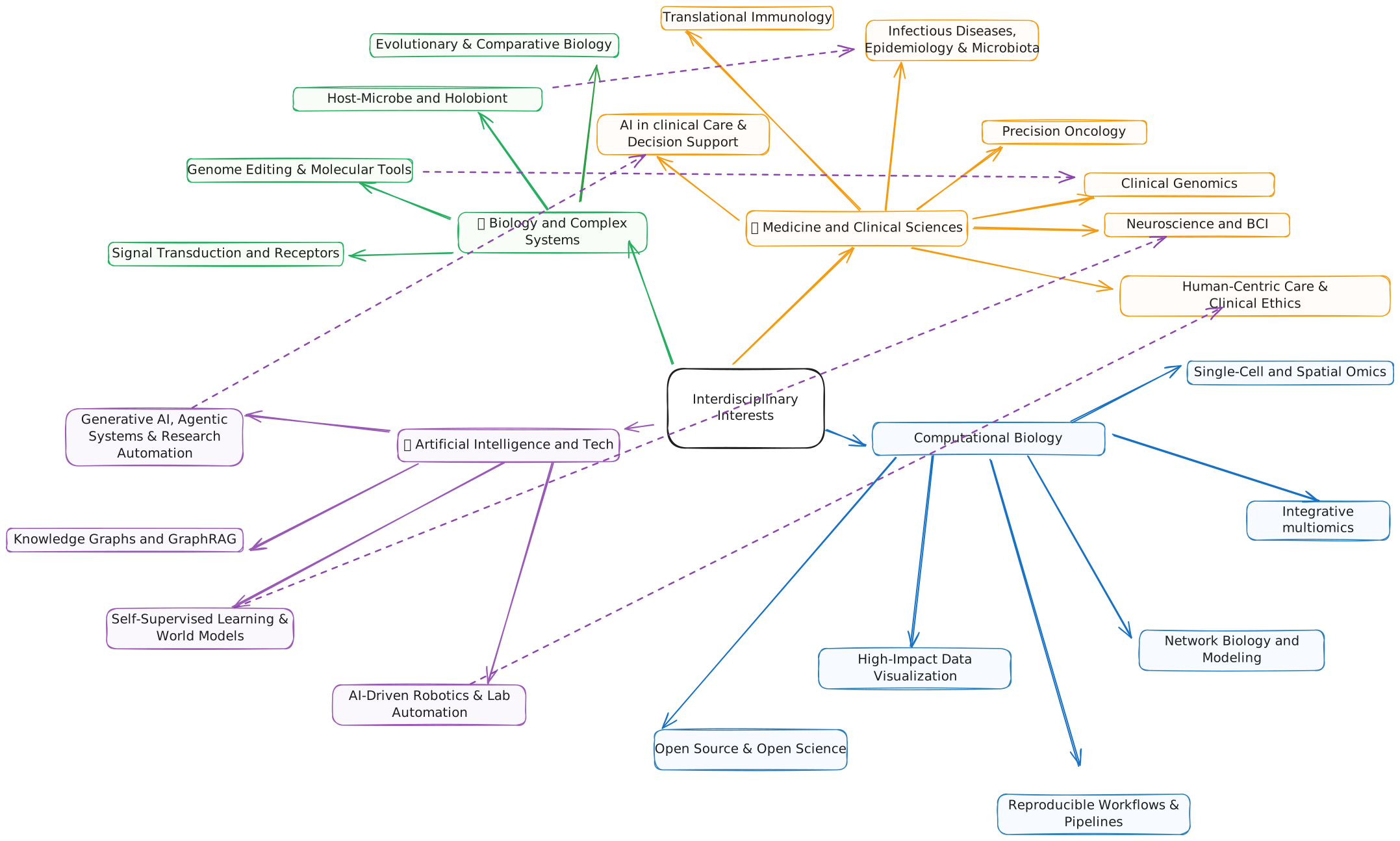
Interdisciplinary Interests Mindmap

Medicine & Clinical Sciences

My primary motivation for entering medicine is grounded in patient care, human interaction, and the direct clinical impact a physician can have. Alongside this fundamental human aspect, I am deeply interested in how complex datasets and computational models can be leveraged at the bedside to provide personalized and augmented care.

Core Areas of Interest

  • Human-Centric Care & Clinical Ethics: Deeply motivated by the patient-doctor relationship, clinical reasoning, and the ethical dimensions of care. I view technology not as an end in itself, but strictly as a tool to improve a patient’s diagnosis and quality of life.
  • AI in Clinical Care & Decision Support: Exploring how artificial intelligence can go beyond biological data analysis to directly assist doctors in patient care, diagnostics, and daily clinical management.
  • Translational Immunology & Immunotherapy: Understanding how the immune system interacts with pathogens and cancer cells, and how we can modulate these interactions.
  • Infectious Diseases, Epidemiology & Microbiota: Studying host-pathogen dynamics, the role of the human microbiota in susceptibility and resistance, antimicrobial resistance mechanisms, and computational models of disease spread.
  • Precision Oncology: Deciphering the heterogeneous nature of tumors through multi-omic profiling to tailor therapies to individual genomic landscapes.
  • Clinical Genomics & Medical Genetics: Exploring how inherited and somatic genetic variants contribute to rare and complex diseases, and how genomic medicine can guide early diagnosis and prevention.
  • Neuroscience, Neurobiology & AI: Fascinated by the bidirectional loop between neurobiology and artificial intelligence—specifically, how biological brain networks and synaptic plasticity inspire new AI architectures (like neuromorphic computing), and how advanced computational models help decode neural signals, study neurological disorders, and interface with the brain (e.g., via Brain-Computer Interfaces).
  • Advanced Surgery, Robotics & Medical Imaging: Exploring the integration of advanced medical imaging, surgical robotics, and 3D reconstruction models to enhance surgical precision and optimize patient outcomes.

Computational Biology & Bioinformatics

With the explosion of high-throughput technologies, biology has transitioned into a highly quantitative field. I am deeply interested in how computational workflows are applied to dissect complex biological systems.

Active Scientific Watch & Exploration

  • Single-Cell & Spatial Omics: Fascinated by how technologies like single-cell RNA-seq (scRNA-seq), CITE-seq, and spatial transcriptomics reveal cellular heterogeneity and microenvironments in tumors and host-microbe niches.
  • Integrative Multi-Omics: Following the development of methods that combine transcriptomic, proteomic, metabolomic, and metagenomic layers to build holistic systems-level models.
  • Quantitative & Digital Phenotyping: Following how image processing, computer vision, and machine learning are applied to automate the extraction of complex phenotypic traits from high-throughput biological and clinical imaging datasets.
  • Network Biology: Interested in how metabolic and signaling network models predict cellular responses and how perturbations (such as drug treatments or mutations) impact system outcomes.
  • High-Impact Data Visualization: Strong advocate for clear and accessible scientific communication through interactive dashboards, Quarto websites, and dynamic network diagrams.
  • Reproducible Workflows & Pipelines: Strong advocate for the principles of reproducible science, specifically through the study of workflows like Nextflow, Docker/Singularity, and Python/R to ensure scientific pipelines are robust and shareable.
  • Open Source & Open Science: Supporting open source repositories and reproducible research practices to make scientific knowledge freely accessible.

Biology & Complex Systems

Before data can be analyzed, we must understand the elegant biochemistry and evolutionary rules that govern living organisms. My foundation in life sciences grounds my understanding of computational models in actual biological mechanisms.

Core Areas of Curiosity

  • Host-Microbe Interactions & The Holobiont: Studying how host organisms and their associated microbiota communicate, co-evolve, and maintain health. I am fascinated by how the microbiome influences immunology, metabolism, and even neurological functions.
  • Evolutionary & Comparative Biology: Fascinated by evolutionary trajectories and comparative genomics to understand regulatory elements, proteins, and genes across diverse taxa.
  • Genome Editing & Molecular Tools: Following the advancements in genome editing technologies, specifically CRISPR-Cas systems, base editing, and prime editing, and their applications in therapeutic correction and functional genomics.
  • Peptides & Receptors: Studying the structural dynamics of ligand-receptor systems to understand signal transduction pathways.
  • Molecular Signal Transduction: Intrigued by how cells sense external stress signals and execute complex gene expression programs to adapt.

Artificial Intelligence & Technology

AI is rapidly evolving from a prediction tool into a discovery engine. I actively follow the rapid advancements in machine learning architectures to understand how they can solve complex technical, computational, and visualization challenges.

Active Scientific Watch & Exploration

  • Generative AI, Agentic Systems & Research Automation: Fascinated by the rapid progress of Large Language Models and agentic AI architectures designed to automate complex computational tasks, drive autonomous research workflows (e.g., “AI Scientists”), accelerate software programming, and synthesize scientific literature.
  • Knowledge Graphs & GraphRAG: Fascinated by the intersection of Large Language Models and Graph Databases (such as Neo4j) to build Retrieval-Augmented Generation (GraphRAG) pipelines, enabling precise, multi-hop reasoning and structured information extraction from biomedical literature and databases.
  • Self-Supervised Learning & World Models: Following the development of advanced self-supervised architectures, specifically JEPA (Joint Embedding Predictive Architecture), to construct predictive world models capable of planning and reasoning in complex environments.
  • AI-Driven Robotics & Lab Automation: Intrigued by how collaborative robotics (cobots) can execute high-throughput experimental workflows driven by predictive world models, and how these AI-driven physical systems parallel the rapid advancements in surgical robotics and autonomous clinical interventions.
  • Medicine & Clinical Sciences: Translational immunology, infectious diseases & microbiome, precision oncology, clinical genomics, neuroscience, brain-computer interfaces, surgical robotics.
  • Computational Biology: Single-cell & spatial transcriptomics (scRNA-seq, CITE-seq), integrative multi-omics, quantitative digital phenotyping, network biology, reproducible pipelines.
  • Artificial Intelligence: Generative AI & agentic architectures, GraphRAG & biomedical knowledge graphs, self-supervised learning & predictive world models (JEPA), lab automation.
Back to top